Friday, 30 August 2013

Parle vous tumblr?

If language creates its own reality (Van Luyn, 2013), then tumblr has formed its own dialect for communicating and creating place in a virtual space.

(Image 1: FBCover24.com, 2013)


This week’s reading, Tuan’s Language and the making of place (1991), offers powerful insights into the power of language and words ‘to render [the] invisible, visible’ and impart certain meaning to the formerly unattended notion or object (Tuan, 1991). It is in this manner I wish to examine the language of ‘tumblring’ and how bloggers interact and form places or profiles in the untouchable and invisible space that is the cyber world.

Communication on tumblr is a process of blogging, re-blogging, liking, commenting, adding, deleting, un-following and browsing; all within the domain of this micro-blogging platform. As argued elsewhere (Tuan, 1991, 693), ‘[users’] have the power to build... [and] to destroy’. If I no longer enjoy the post put up by smashin-pumkins, click delete. I see a photo of the Eiffel tower I like, click re-blog thus creating a new place on my page. I like the posts of missmonroes so I click follow and enable frequent interaction with this user’s profile. This interaction and communication, much like the image above, are more about the implied meaning and rely heavily on symbolism. It is apparent that social networking sites like tumblr heighten our ability to both create and destroy place.  

Thus drawing from my own experience on tumblr, I feel I have been exposed to more creative power, artiscally and in my active role of place-making. I have the power to create my own user name, chose who I want to follow, what pages and posts I view right down to the colour, font and layout of my own profile. Given ‘space becomes place by people imposing meaning on it’ (Van Luyn, 2013), the cyber space of my tumblr profile is effectively transformed into my place by the imposed meaningfulness of layout, colour, text and the posts I blog on my tumblr profile. I render the ‘invisible’ aspects of my personality and my own sense of style ‘visible’ to other tumblr users. If you have the time, check me out: http://bonne-nuit-minuit.tumblr.com/  

APA reference list:
Tuan, Y. (1991). Language and the making of place: A narrative-descriptive approach. In Annuals of the Association of American Geographers, 81(4), 684-696.
Van, Luyn. (Lecturere). (2013, August 28). Narratives and Place. Podcast retrieved from
https://learnjcu.jcu.edu.au/webapps/portal/frameset.jsp?tab_tab_group_id=_312_1&url=%2Fwebapps%2Fblackboard%2Fexecute%2Flauncher%3Ftype%3DCourse%26id%3D_50513_1%26url%3D

Image reference list:
FBCover24.com. (2013). Retrieved from

https://www.google.com.au/search?hl=en&site=imghp&tbm=isch&source=hp&biw=1366&bih=667&q=i+done%27t+like+you+i+love+you&oq=i+done%27t+like+you+i+love+you&gs

Monday, 26 August 2013

Similarities and Differences


To say Songlines and the virtual communication network have nothing in common is to only look from a surface deep perspective. It is through the understanding of how virtuality becomes a reality in both cultures, and how this shapes personal identity and creates community; that you begin to see similarities.

I must confess that being an Indigenous Australian myself, initially I found it extremely hard to look past the comparison of such a rich Dreamtime concepts, such as Songlines with the new age technology of virtual communication networks. To me these two networks are not on the same level to compare. However I was happily proven wrong.

Both, the Dreamtime concept of Songlines and virtual communication networks are virtual worlds. To understand how these virtual worlds can be brought into reality, we firstly need to understand the transcending nature of each cultural group. Indigenous people believe Songlines are reality, to understand this non- Indigenous people must as Stanner suggests, “learn to think black, not imposing western categories of understanding but seeking to conceive of things as the black fellow himself does”.

Non-Indigenous peoples’ ability to understand how virtual worlds become reality is new and developing. I believe non-Indigenous peoples’ ability to understand Songlines is increasing through the understanding of the virtual world. Facebook for one example “has been designed to become part of the users’ daily lives, and [shapes] their offline narratives and selves in Facebooked ways” (McNeil, 2012). Like the way Songlines has the ability in Aboriginal culture to be sung into reality, Facebook in non-Indigenous culture has become a reality through its ability to shape the users’ “offline narratives” (McNeil, 2012). In deepening this understanding Barnes suggests cyber space manages to “engage the viewer in a virtual transportation”. Reiterating this, Margaret Morse states the “viewer [leaves] reality and [moves] into another world”.

Along with understanding how virtuality becomes a reality, the individuals’ identity becomes the centre of question. McNeill states, “since the World Wide Web debuted, more nuanced understandings of identity in cyberspace have emerged, suggesting close connections between “real” and “virtual” selves”. In order to contrast self we draw on narrative (Van Lyun 2013), from both the real and virtual world; such as Facebook, SIMS and for Indigenous communities Songlines. These narratives are all apart of who we are and how we connect ourselves to a community. One’s identity on SIMS and Facebook is heavily developed “by the connections that she [or he] chooses to establish with other individuals, activity groups and religion and secular organizations” (McNeil, 2012).  This meaning that the community chosen on Facebook and SIMS has major influence on ones virtual identity. Songlines unlike Facebook and SIMS doesn’t have the ability to choose its community. Facebook gives the user the ability to privatize their profile, giving access to only the chosen family, friends and groups, or otherwise the user can also chose to open up their timeline to the global virtual world. It is all up to the user. SIMS similarly to Facebook, gives the user the ability to create a community with the ability to invite others in. Songlines on the other hand, is a birthright. It is not a choice of the individual. Although it can be shared with others, it does not have the ability to choose another community or group.

In concluding, to say that Songlines and virtual communication networks are completely different is only a surface deep perception, as they do indeed have similar concepts. However to say they are similar is to completely ignore the clear and obvious differences. Like any concept or topic, you can connect the dots where they fit, but this doesn’t mean they are on the same level to compare.


Reference List:


    Barnes, G (1997). Passage of the Cyber- Flanuer. Otago University.

    McNeill, L. (2012). There is no "I" in network: social networking sites and posthuman auto/biography. Biographical Research Center.

    Morse, Margaret. An Ontology of Everyday Distractions: the Freeway, the Mall, Television in Logics of Television Indiana University Press.

    Stanner, W.E.H (1979) White man got no Dreaming. Australian National University Press.

    Van Luyn, A, (Lecturer). (2013 August 20). Networked narratives. Podcast retrieved from http://learnjcu.edu.au

Images Retrieved from www.thesimsresource.com


Sunday, 25 August 2013

Actions Speak Louder Than Words


'The Hitch-Hiker's Guide To the Galaxy' made the 'improbability drive famous, whereby every point of the universe was visited in an instant- thereby giving access to any given point of the universe that the driver may choose. In this fashion, the internet and digital media make the same thing possible, in a virtual sense, kind of an 'everywhen' of the digital dreaming.

'In order to be oriented, one must know how to leave. 'Man's feeling about being properly oriented in space runs deep. Such knowledge is ultimately linked to survival and sanity. To be disoriented is to be psychotic.' (-Wood, D et al. 'The Multiple truths of the Mappable World')

As this quote shows, knowing where you are and how you got there is crucial to mental well-being, and with (almost) every point of the virtual universe accessible at any given moment, orientation to the place one wants to be becomes extremely important. The 'sign-posts' must be read carefully- especially when downloading free software!

Not only is it important to know 'where' you are but also 'who' you are, and maybe even 'who' these other people are! Or does it?

With the growing dependence on the internet for social networking comes a raft of psychological filters; we can work out very quickly if someone is benign or malignant and if we have met them in another place and time. And often it's the fact that someone 'is' who they say are that makes their influence so damaging, especially when it comes to bullying in the school or workplace situation.

Mark Zuckerberg declares; "Having two identities for yourself is an example of a lack of integrity" (qtd. in Kirkpatrick I99).-Mcneil, L. (2012)

But lack of integrity occurs anyway.

On the topic of narrative, I started a music review on my Facebook page this week. It's a narrative. If I said 'Such-and-such played at the pub on Saturday night' that would be a report, if I said '...they rocked the mother-fucking house down!!!' then that would be a narrative. It's a narrative.
But my identity came into question when I tried to create the page- I searched long and hard for the correct category out of those given and the closest I found was as a business or organisation. But after I had given the basic details of the 'business name' and address, the page froze. Eventually I realised it (Facebook) was checking the name against a real-world business register and wasn't going to find it. I re-entered the page as an arts/entertainment magazine and when I was asked if the magazine existed in the real-world or if it was fake, I ticked the 'fake' box. No problem. FNQ Music Mag is up and runnning!

Ceci n’est pas reality


                                                             (Image 1: Katcher, 2011)

As Ferdinand de Saussure argued, this is not a pipe but merely an illustration of a pipe (Van Luyn, 2013). Nor is one’s identity on the social network ‘real’ or ‘authentic’ as Facebook founder Mark Zuckerberg claimed (McNeill, 2012). In the virtual reality of the cyber world, nothing is a single, measurable entity. Rather the cyber world is not natural and knowable, neither is its author, a concept early humanist philosophy cannot solely explain. This argument is further developed elsewhere (Van Luyn, 2013), that in the virtual network you are not the only individual constructing your identity but rather the software, as McNeill (2012) highlights, and other people are co-producing your online-self. Thus we enter the realm of cyber-reality.

Similarly to the song-lines of Indigenous Australians, online users today are inter-connected by the constant sharing of narratives and information that map out the vast and almost inhabitable cyber landscape not unlike Australia was to its first inhabitants (Chatwin, 1987). For instance, when navigating the social network site tumblr, one cannot progress through the site without sharing and re-sharing information with other users. As the song-line enabled Aboriginals to sing things into meaning such as The Dreaming, one can except the networked narratives or multiple tumblr blogs as a ‘complex of meanings’ for understanding one’s on-line self. Just as white man ‘cannot easily, in the mobility of modern life, grasp... the vast intuitions... at the heart of Aboriginal ontology’(Stanner, 1979), the same type of thought cannot be applied when trying to understand the ontology of the cyborg.

 The importance of agency and community within Aboriginal people is equally important in my social network on tumblr. When initially making my profile I indicated what types of blogs I wished to follow: art, music, animals and humour. The tumblr software became my ‘shadow’ biographer by ‘suggesting’ what blogs to follow, those that were quite conservative in regards to the themes I suggested (no nudity in the art or heavy metal music). Clearly the blogs or narratives viewed as more acceptable than others were endorsed here (Van Luyn, 2013). Despite this, one gains empowerment by engaging in the site regularly by searching, locating and re-blogging the information I, the user, like. In this way, tumblr allows ‘mash-ups, re-[blogs] and collaborations’ by active users to be more than consumers (Van Luyn, 2013). To use Axel Burns terminology, tumblr users become ‘produsers’ (McNeill, 2012).  

Chatwin, B. (1987). Chapter 3, in Songlines (pp.11-15). London, England: Johnathan Cape.

Katcher, J. (2011). The Discerning Brute. Retrieved from:
              http://www.thediscerningbrute.com/2011/04/15/the-treachery-of-images/

McNeill, L. (2012). There is no “I” in network: Social networking sites and post-human auto-biography. In Biograohy, 35(1), 101-118.

Stanner, W.E.H. (1979). The dreaming (1953), in White man got no dreaming: Essays 1938-1973 (pp.23-30). Canberra, Australia: Australian National University Press.

Van Luyn, A. (2013). Week 4 Lecture Notes.

Friday, 23 August 2013

A Facebook Autobiography

(Christensen, n.d.)
The distribution of power within online social networking sites may appear to be evenly spread, however when you dig a little deeper, you find that this is not necessarily the case. In social networks such as Facebook, 'friends' = power. The more friends you have, the greater your network community becomes, and the more authority you can obtain over the other members in your 'community'. This is because, when others see that you have many connections, they generate a greater respect for you. You may have heard people boasting about how many 'friends' they have on Facebook. This act brings a virtual struggle for dominance into the real world, consequently aiding to blur the lines between virtual life and reality.

In addition to this, as mentioned in McNeill's biography on There is no "I" in Network, someone's authority and level of respect on Facebook can be determined by the comments posted on their "Wall". If these comments are negative or degrading, then the image of that person will also be poor and vice versa (p108-109).  

McNeill also explores the concept that Facebook is a form of autobiography. The traditional definition of an autobiography is "a history of a person's life written or told by that person" (Dictionary.com, 2013). Facebook is one of the social networking sites that has come the closest to adhering to this definition. This is due to the application of a "Profile" that each member must fulfil to some extent. The members real name must be provided, which is what distinguishes this site from the other networks which allow you to remain anonymous. Facebook is like a story of your life and can therefore be considered an autobiography; however, the fact that others can comment and influence this 'story' is what separates it from the traditional definition (McNeill, 2012).

Another difference between Paperback autobiographies and Facebook is that paper autobiographies have an end or a conclusion. Whereas, Facebook is a continuous story that is constantly being added to. In this respect, Facebook is similar to the Aboriginal concept of Songlines. Songlines are, according to the Aboriginal culture, the lines or paths that their ancestors took when 'singing' the earth into existence (Chatwin, 1987). It was mentioned in the week four lecture that "there is no sense of linear timelines in Songlines" (Van Luyn, 2013). The descendants today continue to travel down these Songlines and sing the same songs as their ancestors to help improve the earth. It is a continuous and collaborative activity, similar to the continuous and collaborative 'story' created on Facebook.

Reference List

Tuesday, 20 August 2013

Virtual Power and Geography


Title: Virtual Power and Geography

There are copious sites available on the Web for social networking. SIMS, a life simulation game is one of them. I recently joined this virtual space to explore a new social network site. However in my analysis I not only found a social network site, I found a three dimensional social space that connects with Buchanan’s (2002) idea that an individual prizes their future, to do and think what they will. SIMS is a space where the user can create a look, a style, a version of themselves, either new, similar or drastically different. Tuan (1977) established that “space and place are basic components of the lived world”. SIMS takes on, and challenges Tuan’s concept by providing a blank canvas for users in the virtual realm, where ultimately a virtual sense of geography is created. 

The power of geography goes back to many historical and political disputes. Allen (2003) states in the opening paragraphs of Lost geographies that most of the geographical disputes over land and territory, at both a government level and a ethnic level occur because geography is the core value. SIMS empowers the user by giving them the ability to create a landscape that reflects their individual values. Just as Allen (2003) states “Geography and power seem to run together in many ways. The connection of geography with power, if ones thinks about it, is pretty much a familiar one”. 


As Dr Kuttainen discussed in Lecture 2, power is unequally distributed. SIMS unlike the theory of domination allows for even dispersal of power rather than “power concentrated in the hands of people of similar status”. In a SIMS world the physical world’s idea of status is irrelevant. Power remains in the imagination and freedom of the individuals mind. This can be linked back to Tuan’s (1977) idea that space and place is influenced by the users “biological facts … relations of space and place … [and] range of experience or knowledge” rather than the status bound power, derived from domination.


Ultimately SIMS is empowering, because regardless of your own status and geography in the physical lived world, the user has the free will to not only reinvent themselves but create a community of their own.  


Reference List:

Allen, J. (2003). Introduction: Lost geographies, in Lost geographies of power (1-12). Malden, MA: Blackwell.

Buchanan, M. (2002).  Nexus: Small worlds and the groundbreaking science of network. New York: WW Norton and Company.

Kuttainen, V. (2012). BA1002: Our Space: Networks, narratives and the making of place, Lecture 2: Power: Big Brother and Self-Surveillance. [PowerPoint slides]. Retrieved from http://learnjcu.edu.au

Tuan, Y. (1977). Space and place: The perspective of experience. London, England: Edward Arnold.
Image Credits
Image 1: Retrieved from Airlandzz

Saturday, 17 August 2013

Shelfari – Power


Shelfari is a social cataloging website designed for books. In this website, users build a virtual bookshelf of tittles of books that they own or have read. Shelfari empowers members to rate, review, tag and discuss about their books. Members can create groups and others can join, create discussions and talk about books of their interests. The virtual bookshelf is used for organising books into different shelves such as already read, currently reading, planning to read, wish list, currently owned and favourites. In this social network I have kept my identity because it is actually an interesting group to be part of and I do not see any reason to lie about who I am or what books I am interested in. I would like the other members to know the real me and also to be able to read, share and explore ideas about all different kind of books.

It is stated in “A turtle on a leash” that it is almost impossible to summon and maintain good moral character in a thickly massed population where each individual, unbeknownst to all the others, hides in the crowd, so to speak, and blushes before the eyes of no one (Prouty, 2009). This being said, I do experience more freedom when I’m in the virtual world because I have the power and courage to voice my opinions without being discouraged and shut down by anyone. Members are not there to judge you on what you like to read but they are there to read, share and explore different ideas about books that interest them. The network designer has the mapped my movement through space of this network by being able to communicate with different people in all parts of the world by being able to share ideas about all different kind of books there is to offer.  The experience of the virtual space does empower me to gain a vast amount of knowledge as I have the control of what I like to read or whom I want to communicate with. I also have the control of groups that I create with other members. It is much easier to communicate with people in this virtual world, as there is no physical contact just in case there is a dispute.

Reference

Prouty, R. (2009). A turtle on a leash. Revised from

Friday, 16 August 2013

The Modern Flaneur

(Hartian, 2012)
There are numerous social networking sites on the Web, and many of these sites are connected to other social networks. For example, I recently joined a social network called 'LiveJournal', which not only has its own personal website, but a twitter and Facebook page as well. "LiveJournal is a community publishing platform, willfully blurring the lines between blogging and social networking" (LiveJournal. Inc: About Us, 2012). Not only are members able to express themselves and communicate with friends, but also interact with the wider community. This community is not restricted to one particular place as seen in the physical world, but is a community shared between many different nations. 

For such an extensive reach and numerous interactions with other social networking sites, a map to know where everything is would be beneficial. It just so happens that LiveJournal provides a 'Sitemap' on the bottom of the page. This map contains links to all the different sections and applications of the website and therefore makes it easier to coordinate oneself through the various pages. However, it is not so comprehensive as to portray everything the site has to offer, such as the various journals written by members. Therefore allowing the visitor the opportunity to act as a flaneur, and meander or explore the countless journal entries while remaining anonymous. In fact, it is much easier for the flaneur to act in the virtual world rather than the physical one.

A flaneur - as depicted by Prouty (2009) - is someone who feels as much at home in the city streets as one would in the comfort of their own home. They observe the city and its residents silently from the sidelines. Now, the modern flaneur has it much simpler, due to the fact that they don't have to worry about being seen or miss out on interesting information that could easily be missed in the real world, due to the benefits of the internet and social networking sites that retain data. It is much easier to get lost in the virtual world because you can search further and faster than in the physical world, however this can be seen as an added bonus to the flaeur. It can be difficult to follow a map through the virtual world as they do not look like the traditional world maps as portrayed in this week's lecture (Petray, 2013), but are instead a collection of links to places you can go from where you currently are, and the places you have been previously. 

As explained in this week's lecture, maps are constructed for a particular purpose and can therefore take on many different forms. The way that the map is constructed shows who is in power by placing the power holder in the centre. In the case of the Sitemap on LiveJournal, the centre of the map is you, so you are therefore the one in power. This type of reader centred map is common in the virtual world.  

Reference List

Mini-maps in a Virtual World

Maps are an essential tool in navigating, virtually or otherwise. Whether the distance between point A and point B is short or long, a map would be able to show you all the possible routes to where it is you need to go. Of course, it would be helpful if both points were on the map, but one could always find a bigger map, right?

But with a bigger map, a loss of detail is to be expected. Smaller maps have more detail of your immediate surroundings, larger maps allow you to see more of what is out there. So is there a happy medium, something that has a little bit of both?

Well, yes and no. As Abramms, Kaiser and Wood (2006, pg. 8) state; ‘all maps are selections from everything that is known, bent to the mapmaker’s purpose.’ The size and detail of the map depends on what the mapmaker had intended for it’s use.


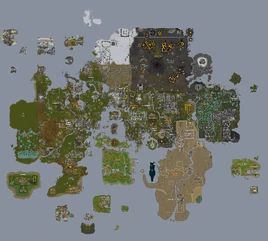
The world map for Runescape, my chosen virtual network, is massive. As with any MMORPG, a mini-map is used for local navigation instead. It is smaller, more detailed than the world map and constantly updates with you at the centre of its focus. It also acts as something like a tourist’s map; icons pop up to point out important places of interest (Petray, 2013). The icons that show up often relate to you and what your character needs i.e. a quest giver or a dungeon.

Mini-maps are a great example of what can be classified as a ‘special purpose map’, a map made to show how to get to a specific place that is tailored to suit your needs. Likewise, the world map can be classified as a ‘general purpose map’, or something that simply shows you what the world around you looks like. (Abramm, Kaiser, and Wood, 2006)

References

Abramm, B., Kaiser, W. L., Wood, D. (2006) Seeing through maps: Many ways to see the world. (pp 1 - 12). UK: New Internationalist Publications.

Petray, T. (2013). Lecture: Seeing and shaping the world, via LearnJCU

Image Reference

Map of RuneScape (n.d.) RuneScape Wiki: RuneScape world map. Retrieved 16th August 2013 from http://runescape.wikia.com/wiki/File:RuneScape_Worldmap.png

A Virtual Reality


A Virtual Reality


The space around us is relevant to the individual. Many things occur at any one time however it is want we observe, learn or who or what we interact with, that defines the space around us (Wood, W.L, & Abramms, 2006)

In today’s society, approximately one billion of us communicate via Facebook (Kiss, 2012). For many, this is part of their “space” that they know to be true as they experience many different interactions through the social network. 

They relatively new growth of communicating via virtual networks can be related to the historical figure of the flâneur. As Prouty (2009) discussed, the description of flâneur developed as the result of urbanism in the late 16th century in Paris. This urbanism can now be seen on the web in the form of blogs, social networks, wikis, internet forums, etc. The same way it was difficult for the authorities to police late 16th century Paris, it difficult to police what users put out on the web. This allows the user a power that in reality they may not have without consequence. 

With Tumblr, my chosen virtual network, it is easy for the everyday person to create a space that is true and unique to them. The microblogging platform allows the user to post multimedia and other content to a short-form blog. Users can follow other users' blogs, as well as make their blogs private. This allows the creator of the blog the power to privatize or expose their blogs to whomever they want. 


References

Kiss, J. (2012, October 4). Facebook hits 1 billion users a month. Retrieved from The Guardian: http://www.theguardian.com/technology/2012/oct/04/facebook-hits-billion-users-a-month
Prouty, R. (2009, October 28). Aesthetics & Politics . Retrieved from One-Way Street: http://www.onewaystreet.typepad.com/one_way_street/2009/10/a-turtle-on-a-leash.html
Wood, D., W.L, K., & Abramms, B. (2006). Chapter One. In D. Wood, K. W.L, & B. Abramms, Seeing Through Maps: Many Ways to See the World (pp. 1-12). Oxford: New Internationalist Publications.